Friday, May 15, 2020


This Week In Grade One
May 19-22
Task One
English Language Arts
Weekly Wellness Story 

Listen
Listen to the story Alexander and the Terrible, Horrible, No Good, Very Bad Day

Discuss
Take a look at the Zones of Regulation poster. What are some of the feelings in each Zone? 
Look at the attached pictures of Alexander from the story. Try to match each picture with a Zone.
Take a picture of yourself in one of the Zones and send it to your teacher to see if she can guess what it is!

Draw and Write
What do you think would have helped Alexander get back to the Green Zone? Draw a picture of him feeling calm and happy. Add pictures or write down the things he did that helped him feel better.

Links
Learning Intentions
I can recognize and demonstrate various ways to express feelings; e.g., verbal and nonverbal. 
I can identify positive and negative feelings.
I can identify physiological responses to feelings; e.g., being sad can make you tired.
I can share personal experiences that are clearly related to a story.
Optional Extensions
Create a Zones Check-In for your whole family. Watch the “Zones of Regulation Check-In” video and choose a check-in that works for you. 
Task Two
English Language Arts
Writing Check-in

Today students will be completing an independent writing check in. This helps us to see what they are able to do completely independently. Once they start drawing/writing, please do not help them with this task (sounding out words, reminding them about punctuation, etc).

You can watch the video called “Writing Check-in Instructions” to hear these instructions, or you can explain the activity to your child using the following information:

Task:

Choose one of the picture prompts provided. 

Students are going to write about what is happening in the picture. Here are some things to think about: 
-what happened before this picture? 
-what happened after this picture? 
-what is happening in the picture? What are the characters thinking?

You can print off one of the writing templates, write in your own journal or on a piece of paper.

Your writing should include: 
-at least 4 sentences (you can ALWAYS write more)
-a detailed “wow” picture 

When writing remember to:
-spell sight words correctly 
-sound out unfamiliar words (kid printing)
-leave finger spaces 
-use upper and lowercase letters in the right places
-include punctuation at the end of each sentence

After writing: 
Look at the Grade 1 writing samples that are provided. Ask your child which sample they think matches their writing the most. Talk about what they have done well! Ask your child to set a goal, something they will focus on the next time they write (for example, I will make sure to use punctuation or I will focus on my sounding out words I don’t know).

**Please submit a picture of your child’s writing sample to their teacher**
Links

Learning Intentions
I can write four sentences
I can draw a detailed picture
I can write using sight words and kid printing (sounding out words)
I can leave finger spaces between words 
I can use punctuation at the end of each sentence
I can use upper and lowercase letters in the right places 
Optional Extensions
Edit your writing using the writing checklist. 

Task Three
English Language  
Mason Bee Research

We have bees! Mrs. Pittman and Mrs. McCaw have some visitors in their backyards these days. Mason Bees! You might think why are Mason Bees important and why are we learning about them? Well let’s find out together!

Mason bees are beautiful, gentle native bees that are also excellent pollinators. Before honeybees were brought over from Europe; native bees, like mason bees, did all the pollinating here in North America. Mason bees do not produce honey – they collect pollen, whereas honey bees collect nectar.

Use the links provided or complete your own search to learn more about these busy little creatures. Create an information Brochure teaching people about the Mason Bee and how important they are to humans and our environment. This task will take you at least two days so take your time and do your best work!

Questions to research:
·  Why are bees so important to our earth?
·  What is the ideal habitat for the Mason Bee?
·  What do Mason Bees eat?
·  How are Mason Bees different from Honey Bees? Create a Venn diagram comparing similarities and differences between the Mason Bee and the Honey Bee. See attachments for an example of a Venn diagram.


Mason Bee Life Cycle

The Mason Bee life cycle goes as follows:
Egg~Larva~Pupa~Adult

Task: using the pictures provided sketch the lifecycle of a Mason Bee. Please add scientific drawings and labels. Remember a cycle means it continues, once it is at the adult stage it starts over again. What shape demonstrates this? Put this into your brochure.


Links

Learning Intentions
I Can Statements:
·  I can research an animal or insect
·  I can explain the importance of the Mason Bee
·  I can identify key characteristics of the Mason Bee
·  I can document my learning

Optional Extensions
Optional Extension:
Make your own Mason Bee Habitat!
Watch the video provided and create your own Mason Bee home.
Make sure to send your teacher a picture so that we can share it with your friends.

          Math
Measurement

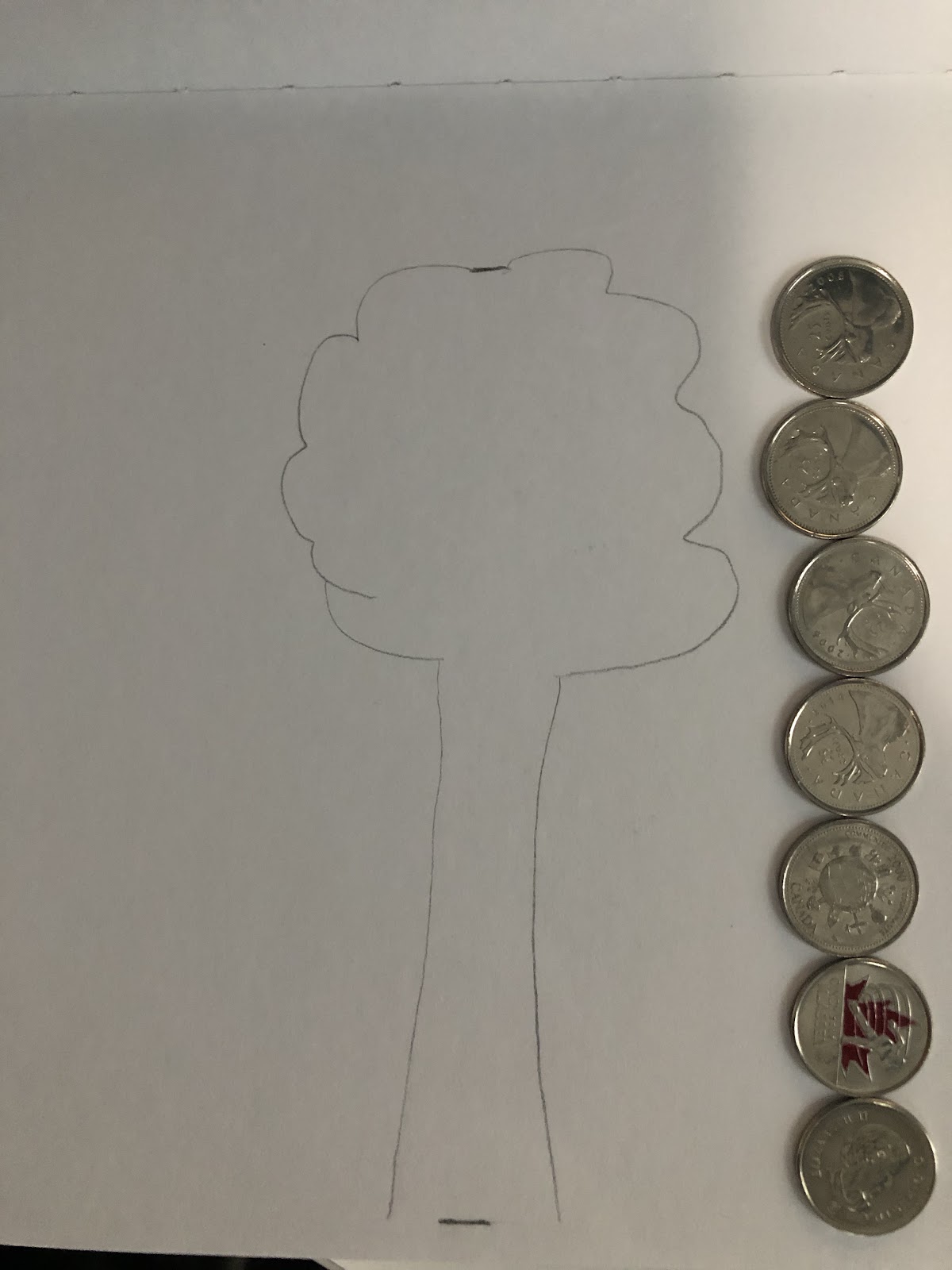
Create a picture following the instructions. You will need one type of coin. You can use one or many but make sure if you choose to measure in quarters, all your coins are quarters, if you choose dimes, all your coins are dimes etc. If you don’t have coins you could use another small object like lego. Just make sure all the pieces are the same size. Read all the instructions ahead of time so you can plan the space on your page.

Draw a tree that is 7 coins tall
Draw a pond that is 4 coins long from one side to the other. 
Draw 2 ducks that are each 1 coin tall.
Draw yourself 3 coins tall. 
Draw a cloud that is 3 coins wide and 1 coin tall.
Add one more thing to your picture and show the measurement. For example: a dog and label that you made it 2 coins long from its nose to tail.
Colour your picture.


Links/Resources
Learning Intentions
I can accurately measure with nonstandard units

Optional Extensions
Follow the same instructions to draw the picture but use a different sized object. Compare your pictures. What happens when you use a smaller object? 
Math  

Counting A Set of Objects

Read
Read the story “The Gnomes Count”

Discuss
How did the Gnomes figure out how many gems there were?
What are some groups we can make to make counting quicker and easier? (Hint: 2, 5, 10)

Try
Find some small objects to count. You might use rice, dried beans, cereal, beads, anything you can pick up a large handful of. 
How can you arrange these objects to count them quickly?
(if you want to keep track of your groups, try drawing circles on a piece of paper, and placing each group in one circle)
Can you put them in groups of 2? 5? 10? How many do you have? Record your answer.
You can also try counting the pieces in the minion puzzle in the link. What strategy did you use?
Links

Learning Intentions
I can count by 2s forward from 0 to 20. 
I can count by 5s and 10s forward from 0 to 100.
I can show my understanding of counting by using parts or equal groups to count sets.
Optional Extensions
Finding counting groups tricky? Forgetting how to skip count?

Try practicing on a 100s chart (found in class learning tools or use THIS interactive one online). Try counting by 2s, 5s, 10s. Make them different colours and see if you can find any patterns.
Try this fun workout to exercise and practice at the same time: Workout and Count!

Finding counting groups easy? 2s, 5s, and 10s are no problem? 

Try challenging yourself by making groups of harder numbers. Count by 3, 4, or 8!
Here’s a little practice song to get you started: Counting by 3s

Math 
Math game

Subtraction SNAP

This game is a simple revision of the traditional card game of war. This game challenges players to quickly perform mathematical operations in their head to beat their opponent. For this game we will be focusing on subtraction. You will need one deck of cards, only the cards from 1-10 will be used. Each player is dealt an equal number of cards from the deck, which they keep face down in a pile. When the players say “Go”, each player flips over the top card from their own deck and show each other their card. The first player to call out the difference (subtraction) between the cards takes the set of cards and sets them aside. The players immediately flip over the next top cards in their deck and repeat. The player with the most cards when the deck is finished wins. 

If there is a tie, each player draws three cards from their deck and places them face down, then each player draws a fourth card and the first person to call out the difference between the two cards (subtraction) wins all of the cards. 

Learning Intentions: 
I can answer subtraction questions to 20.

Optional Extensions: 
If the game is too simple, you can make it more challenging by having each player flip over two cards. First, each opponent will add their two cards together to find the sum, then you will find the difference between the two numbers. 
Complete one of the 4-in-a-row math subtraction games, linked below.
Math
Math Problem Solving
Draw a picture of a tree, a bird bath and background. See attachment for an example. Use this picture to help you solve the following word problems. Draw the problem out so that your thinking is visible. Write a number sentence to match your bird story. (6 + 3=9)


Bird Problems: Remember to show your work on your bird bath picture. You can use a white board or draw three different pictures.

Problem #1:
On a warm spring morning, there were 13 birds in the giant apple tree. A warm breeze blew in and 7 of the birds flew to the bird bath for a cool dip in the water. How many birds were left in the tree?

Problem #2:
It was a blistering summer day and the bird bath was full of little chickadees. There were 8 chickadees all cooling themselves in the water. Snickers came out and started barking at the birds and scared 5 of them away to the shelter of the big apple tree. How many chickadees are left in the bird bath?

Problem #3:
There were 18 birds all together. Nine of them were taking a dip in the bird bath. How many were relaxing in the big apple tree?

I can statements:
·  I can understand what the question is asking me to do (add/subtract)
·  I can represent my thinking through an illustration
·  I can figure out the answer by using my drawing to help me
·  I can write a number sentence


Optional Extensions
Can you make your own animal math story? Draw the picture and write out the story. Share it with a friend or family member. 

Friday, May 8, 2020

Week 6 Lesson Plans


This Week In Grade One
May 11-14
Task One
English Language Arts
Weekly Wellness Story 

Listen to the story, “No One But You” 

After listening to the story, write down your answers to the following questions: 
  1. What makes you unique/special? 
  2. What are some things you are amazing at? 
  3. What are some things that you notice and wonder about the world around you?

Then, ask your parents what makes your family special!
Do you have any special traditions, celebrations or holidays?
What languages are spoken in your family? 
How has your family changed over time? 
What does your name mean? What does your family name mean? 
Has your family lived anywhere other than Calgary? If so, what brought you to Calgary? 
Are there any special stories that have been passed down in your family? 
Are there any special people in your family that maybe you have never met? 
What other interesting facts can your parents share with you? 

Choose a way to show what you have learned about how your family is unique/special. You could paint a picture, use loose parts, create a short video or come up with your own idea about how to share your new knowledge!
Links
Learning Intentions
I can record my ideas using pictures and print. 
I can identify my interests, strengths and skills.
I can identify ways that my family is unique, including languages, traditions, celebrations and stories.
Optional Extensions
Interview a member of your family (parent, sibling, grandparent). Ask them the same questions. 
  1. What makes you unique/special?
  2. What are some things you are amazing at?
  3. What are some things you notice/wonder about the world around you? 
Choose a way to record their answers (writing/pictures).
Task Two
English Language Arts
Poem Study: Word Work

Read and listen to the poem Ickle Me, Pickle Me, Tickle me too written by Shel Silverstein taken from Where the Sidewalk Ends the poems and drawings of Shel Silverstein.


ICKLE ME, PICKLE ME, TICKLE ME TOO
Written by: Shel Silverstein

Ickle Me, Pickle Me, Tickle Me too
Went for a ride in a flying shoe.
"Hooray!"
"What fun!"
"It's time we flew!"
Said Ickle Me, Pickle Me, Tickle Me too.

Ickle was captain, and Pickle was crew
And Tickle served coffee and mulligan stew
As higher
And higher
And higher they flew,
Ickle Me, Pickle Me, Tickle Me too.

Ickle Me, Pickle Me, Tickle Me too,
Over the sun and beyond the blue.
"Hold on!"
"Stay in!"
"I hope we do!"
Cried Ickle Me, Pickle Me, Tickle Me too.

Ickle Me, Pickle Me, Tickle me too
Never returned to the world they knew,
And nobody
Knows what's
Happened to
Dear Ickle Me, Pickle Me, Tickle Me too.

Who are the characters in this poem?
What were the characters doing?
How many sight words do you notice? (tip: use the Dolch sight word list to help you)
Do you hear rhyming words? Write them down?
Dialogue is when characters are speaking. Do you hear any dialogue in this poem?
Do you notice any words that have sound blends within them? For example (ing, er, ea, ie, sh, th, ow, oi).
Choose 5 (five) new words and learn how to spell them. Use them within a sentence. For example, if I choose the word “world” I could write- “The world is very big and round”.
What image does this poem conjure up in your brain? Can you draw, label and colour your pictures.


Links
Learning Intentions
I Can Statements:
·  I can listen to a piece of writing and understand who the characters are.
·  I can hear rhyming words.
·  I can identify sound blends.
·  I can respond to a poem both verbally and pictorially.
Optional Extensions
Optional Extension:
Readers Theatre: Find a short poem that has dialogue in it. With a family member learn the words to the poem and perform a Reader’s Theatre for the rest of your family or record it. (Tip: reading with expression makes the reader’s theatre more interesting and exciting for the audience.) If you are comfortable sharing your readers theatre with your classmates we would love to see it!

Task Three
English Language  
What is an Insect?

Background: All animals belong to different groups and they are put into these groups based on characteristics. Some groups are reptiles, birds, mammals and insects. For example animals in the reptile group have scales, are cold blooded and lay eggs. Birds belong together in a group if they have feathers and lay hard shelled eggs. Today we will figure out what an animal has to have to be in the insect group. 

Watch the 2 short videos called “Inspect an Insect” and “What is an Insect?”

Listen to find out what makes an insect an insect. Focus on the body parts and you can use the diagram to help you remember what they are called and where they are. 

Tell what an insect is and what it has (6 legs, head, thorax, abdomen, antenna, wings). To show that you really understand, choose an animal and tell why it is NOT an insect. 

A scientist who studies insects is called an entomologist. 

Task: You are an entomologist. When you went out for a walk one day, you discovered a new insect that no one has ever seen before! You want to document your findings clearly so other scientists can learn from your discovery. 

1.Create a detailed sketch of the insect you discovered. Look at the picture of insect examples. They all look very different! Make your insect creative and unique! 
2. Make sure to label the parts to show that it fits in the insect category. 3. Show the colours of your insect. 
4. Write 3-5 sentences about your insect. Some ideas include: 
-where it was found
-why you think it has the colour it has (does it help the insect hide or scare away predators?)
-a special way it might protect itself from predators
-explain its body parts or what it eats 
Links
Learning Intentions
I can gather and apply information
I can create a coloured, detailed, labelled sketch
I can explain what makes an insect an insect
I can use my writing checklist to check for:
-capitals and periods
-lowercase letters
-sounding out words
-spelling some sight words accurately
Optional Extensions
Go outside and look for insects. See if you can identify their body parts.
Visit this site to learn more about other groups of animals.
Task Four
English Language  
Fiction vs. Non-Fiction Story

Listen
Listen to the fiction book:
The Curious Garden
And the non-fiction book:
In City Gardens

Discuss
Both of these books talk about growing gardens in the city. One is fiction and one is non-fiction. 
What does fiction mean?
What does non-fiction mean?
How can you tell which book is fiction?
Compare the books- what is the same? What is different?
Why do we like both kinds of books? What is their purpose?

Create
Choose two plants to draw- one fictional (make it up!) and one realistic. Label the parts of your plants. 

Examples:
A cookie vine and a grape vine.
A sparkle flower and a tulip.
Links
Learning Intentions
I can compare similarities and differences.
I can categorize information.
I can respond to stories with writing and drawing.
Optional Extensions
Do a Curious Garden photo walk. Bring a phone, camera, or tablet on a walk. What plants do you see springing up around the neighbourhood? Take a picture of the plants and flowers that you see. What do you notice? Can you identify them?
          Math
Subtraction Practice 

Watch the video “The Action of Subtraction” 

After watching, explain to someone in your family what subtraction means. Ask them to record you sharing your explanation and share it with your teacher. 

Choose two of the following questions to complete. Remember to show your work using pictures and a number sentence (ex. 10-5=5). You can use a variety of strategies to solve subtraction problems, including using a number line, a hundreds chart, objects, drawing a picture or counting backwards on your fingers. If possible, have your family record you explaining how you figured out the answer for one of the problems and send it along to your teacher.

  1. Amelia had 8 pieces of pizza. She ate two. How many are left? 
  2. Logan had 11 balloons. 7 balloons popped. How many balloons are left? 
  3. Jessica has 19 cupcakes. She shares 14 with her classmates. How many cupcakes does she have left? 
  4. There are 20 students on the playground. 8 are boys. How many are girls? 

Subtraction Game 

Print off the game board called Subtraction Game, or play on the screen.
You will need a dice and some counters. 
Player 1 rolls the dice. They go to the first column in the row that matches the number on the dice. Using the three numbers in the box, write down a subtraction sentence. Check your work using one of the subtraction strategies that you know (using objects, a number line or counting backwards). Once you have written down a subtraction sentence and checked your work, cover the box up with a counter.
Player 2 rolls the dice and completes the same task.
As boxes in one column are covered up, move to the next column.
Continue taking turns back and forth with your partner until you have a full row that wins 1st, 2nd and 3rd place! 
Links/Resources
The Action of Subtraction 

Learning Intentions
I can use and describe strategies for solving subtraction questions to 20.
I can explain my thinking using pictures, numbers and words.
Optional Extensions
For extra subtraction practice using numbers 1-20, complete the following worksheet:

For an additional challenge using larger numbers, try the following 3 act math problem: 
Math  
Measurement
Our seeds have sprouted! 

The onions, swiss chard, and sunflower seeds are growing. 

Observe
What do you notice in the pictures? 
Which do you think is the tallest? 
Which is widest?
Which has the most leaves?

Create 
Make your own nature comparison like the pinecones in the picture. Choose some items from your yard (it could be grass, pinecones etc.)
Compare them (if it is flowers, maybe you could measure them)
Put your items in order. What criteria did you use? Shortest to tallest? Wide to narrow? Most leaves to fewest?
If you can’t get outside to do this activity, choose items from home that are similar- toy dinosaurs, cars, ponies etc.
Links
Learning Intentions
I can order objects.
I can compare objects. 
Optional Extensions
Try this activity with the people in your family. Who is tallest? Who is shortest? Who has the longest hair? Who has the shortest hair? 
What other criteria could you use to put your family in order?

Math  Cube estimation, counting  
Task 1:

Cube estimation and counting

Step 1. Look at the tall glass of cubes. Estimate how many you think are in the glass. Explain why you chose that number to your parent.

Step 2. Look at the picture of the glass with some cubes on the counter. There are 5 cubes on the counter. Has your estimate changed? How can those 5 cubes help you estimate the amount in the cup. 

Read the clues one at a time to find out how many cubes are in the cup. Kids may benefit from making a number line to 20 and eliminating numbers as they find out more clues.

Clue 1: There is an even number of cubes in the cup. Which numbers  can you eliminate on the number line now that you know there is an even number in the cup.

Clue 2: The number of cubes is between 15 and 22. Think about what you can eliminate.

Clue 3: If I start at 0 and skip count by 5, I will say the number of cubes in the cup.

How many do you think are in the cup?

Look at the “cube counting” picture. What do you notice about how they are placed on the paper? Draw the cubes onto a piece of paper exactly how you see them in the picture then count them. Show your counting strategies. See example below of how students can share their understanding by grouping or writing numbers on their picture. Submit a picture of your work to your teacher.

Learning Intentions:
-I can estimate using a referent
-I can determine if a number is odd or even
-I can skip count by 5
-I can count a set of objects and explain my counting strategy (I skip counted by 2, I made bonds of 10 etc)

Links

Learning Intentions

Optional Extensions
Read through each clue, one at a time, to figure out how many cubes in each cup. While you work through the clues, explain your reasoning for your estimates. Kids will need 20 objects to manipulate into groups as they work through this problem.

The total amount of cubes in the cups is 20. 
Write your estimate for each cup. 

Clue 1: One cup has 6 cubes. Change your estimates if needed.

Clue 2: All cups have less than 10 cubes. Change your estimates if needed. 

Clue 3: 2 cups have an odd number of cubes. 


Math Game

Dotty Six

View the attached image for game rules. After playing a few rounds focusing on 6 dots per square, modify the game and try putting 10 dots in each box. See below for more challenging extensions. 

Discussion during play: 
Ask your child questions while playing to understand their thinking and to give them opportunities to share their strategies.

Some examples are:
Where will you put your dots? Why?
How do you know where to put your dots? 
How many more do you need to win?

Modify the game
-by making the total different (10, 12, 15, 20)
-make a spinner with different number options (with only even numbers, only odds, dice to 10 etc)
-by making the grid bigger (4 by 4)

Learning Intentions:
-number bonds
-strategic thinking
Links
Math
Math: Estimation Jar

Find a clear plastic or glass jar. Fill the jar with many small objects such as LEGO pieces, hair barrettes, cheerios, marbles…

Count out 10 of the objects and place them aside. This is your referent.

Referent: a referent is a clue as to how groups of objects look. You are referring to the referent to make your estimation.

Estimation: a rough calculation of the value, number, quantity, or extent of something.

With members of your family take turns filling the jar with objects. Show them the referent. Together decide upon a “too high” estimation and a “too low” estimation. All estimations must fall within these too numbers. Use a number line to illustrate where your estimation would fall. Give each family member a chance to estimate the number of objects in the jar.

Next count your objects! Decide on the best way to count your objects. It should be accurate and efficient. You could count by twos, fives or tens. Take a photo of your objects while you’re counting them.

I Can Statements:
·  I can make an estimation
·  I can draw a number line
·  I can count objects by twos, fives or tens

Optional Extensions
Optional Extensions:
Place many objects on a flat surface. I can group the objects and subitize helping me to identify how many objects I think there could be. Subitize is to identify a group of objects without counting.

Welcome to Room 10!

 The students of room 10 have had a very busy first couple of weeks of school. We have been working on settling into the rules and routines ...